This International Women’s Month, the conversation in global mobility cannot be solely about increasing the percentage of women on international assignments, although that matters too. It also needs to be about what is happening to the women already inside every relocation you manage, whether or not their names are on the contract.
After 18 years of helping families relocate to Australia, I want to share what I consistently see on the ground, because what happens to the women in these moves directly impacts the success of assignments.
The Woman Behind the Assignment
There is a woman in almost every relocation you manage, and she is rarely the focus of the programme brief.
She is the partner who followed. She is the one who resigned from her job, pulled the children from school, said goodbye to her community, and arrived in a new country where she knows no one and has no professional identity, at least not yet.
She is the one who will spend the first months setting up the household, managing the school transitions, holding the family together emotionally, and doing it largely alone because her partner is already in the office, busy integrating.
In my experience, this woman carries more than her share. She feels the move more deeply. She holds more guilt about uprooting the children and leaving ageing parents behind and the friends she will not easily replace. She is the first to notice when something is wrong with a child, and the last to admit when something is wrong with herself.
And here is what this means for you as a mobility manager:
When she is not supported, the assignment is at risk. Employee distraction, early repatriation requests, and assignment failure are not always about the job itself. Sometimes, they are about what is happening at home.
Related article: The Invisible Role of Mothers During a Move
The Woman On the Assignment
Only around 14% of global assignments are held by women. That figure has been stubbornly slow to shift but is changing. We are seeing more female-led relocations than ever, particularly in healthcare, education, and specialist professional services.
This is worth celebrating. But it also comes with a responsibility.
When a woman leads the assignment, she is not only navigating a new role in a new country but also carrying the invisible load at home.
The mental and emotional management of the household, the children’s schooling, and the family’s social integration do not redistribute simply because she is the one going to the office. They often just get added to everything else she is already doing.
If your mobility programme was designed with a male assignee in mind, it is worth asking whether it truly sees and supports your female assignees in full—besides the professional , as whole people.
What Good Support Looks Like
Here are the areas worth reviewing in your programme:
Mental Health and Emotional Support
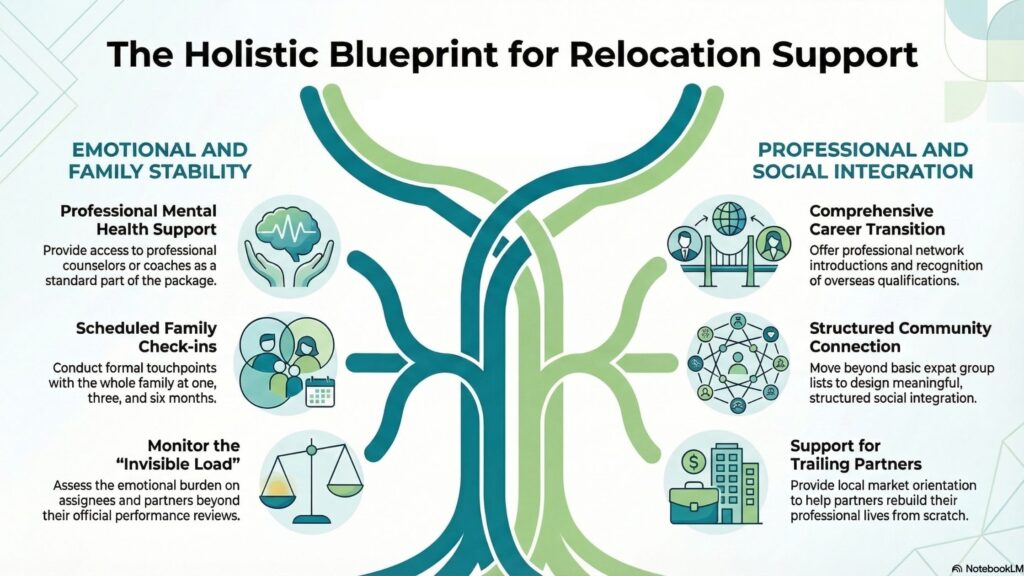
Whether she is the assignee managing a demanding new role or the partner rebuilding her life from scratch, the emotional load of relocation falls disproportionately on women. Thus, access to professional support, be it a counsellor, a coach, or even a structured peer programme, should be a standard part of the support package.
Whole-family Check-ins
The assignee’s performance review tells you how work is going. It tells you nothing about how the family is going. Build in formal touchpoints with the whole family at one month, three months, and six months. Whether it is the female assignee who is struggling to balance her new role with the invisible load at home, or the trailing partner who has not yet found her footing, you will not know unless you ask.
Career Transition Support
This applies in both directions. For the female assignee, it means ensuring her career trajectory is genuinely protected and progressed. For the woman who followed her partner, it means practical support, be it local market orientation, introductions to professional networks, and, where needed, recognition of qualifications earned overseas. A CV review is not enough.
Social and Community Integration
Loneliness is one of the most commonly reported challenges of moving, and it affects both the female assignee who is heads-down in a new job with no time to build a social life and the trailing partner who has all the time in the world but no one to spend it with. Design a structured community connection, not just a list of expat Facebook groups.
A Moment to Reflect
International Women’s Month is a useful prompt to look honestly at your mobility programme and ask:
Are we designing for the whole picture?
The women in your relocations, whether they are leading the assignment or holding the family together behind it, deserve more than an afterthought. They are often the reason the assignment works at all.
The mobility industry has made progress. But there is more to do. And the organisations that get this right will be the ones that the best talent, male and female, actually wants to work for.
How is your organisation supporting the women in your relocations? We would love to hear what is working, what is not, and where you see the gaps. Start the conversation in the comments below.